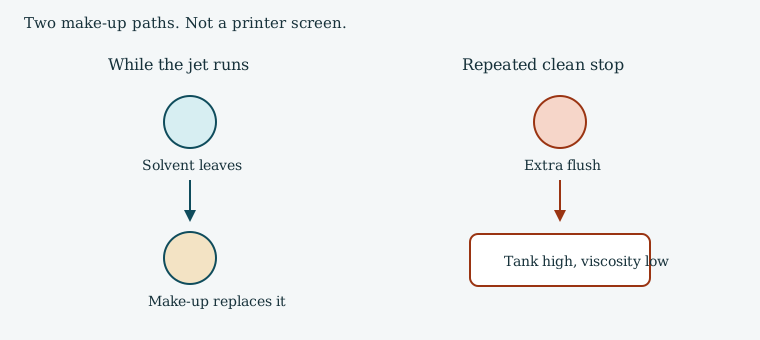
A repeated clean stop wastes make-up and can leave a continuous inkjet printer with low ink viscosity and a high tank level. On the Videojet 1580 and 1550, the stop flush uses make-up fluid. Many start-and-stop cycles use enough make-up to cause that pair of faults. The 1550 manual says quick start and stop must be used to prevent it.
This page is the maintenance record for a printer that is already the coding method. Station choice stays on the industrial inkjet guide. Adhesion of the code that does print stays on the substrate trial record.
What the fluid system is doing
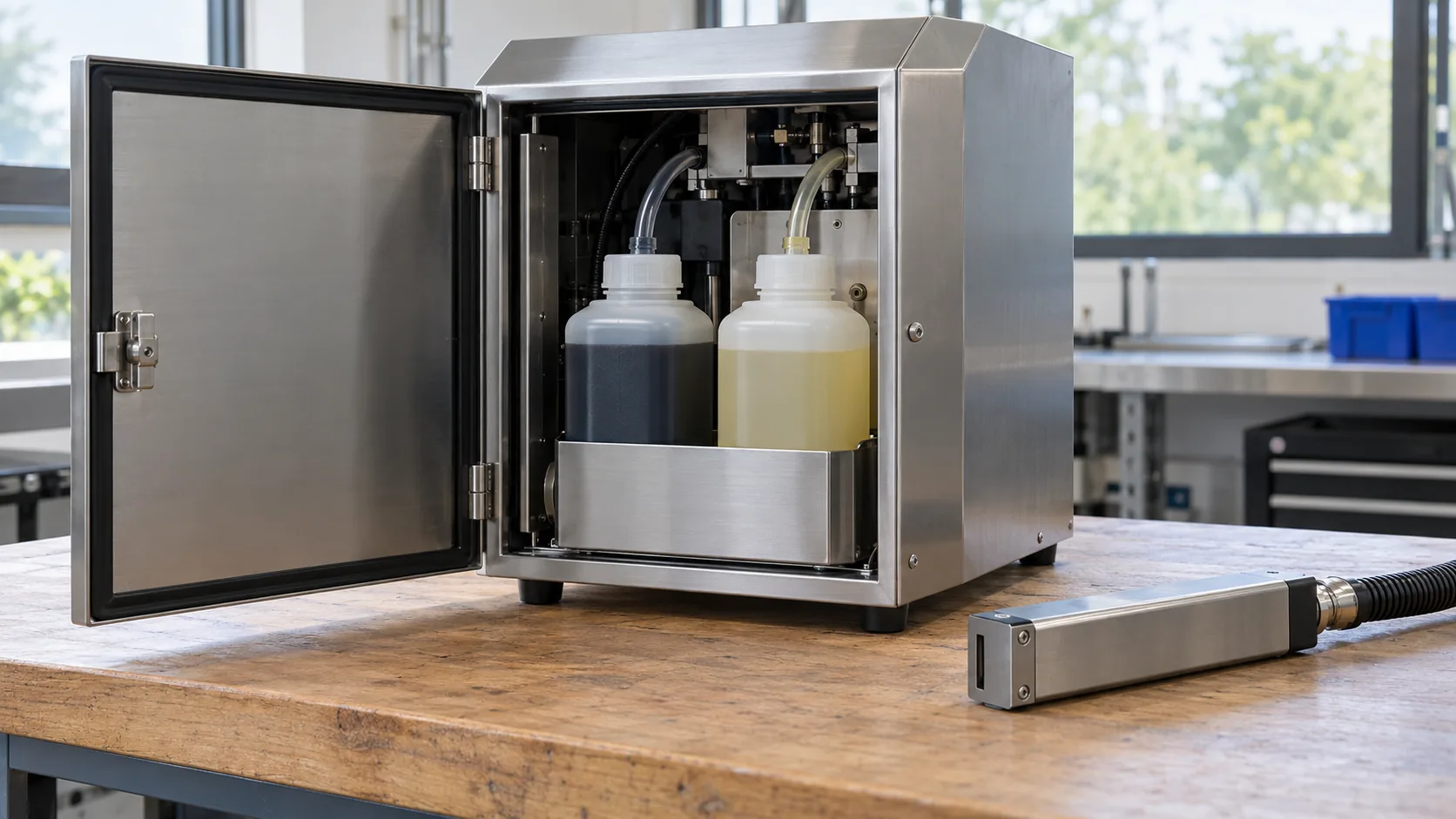
The Videojet 1550 operator manual (P/N 462329-01, Rev AB, November 2012) says the ink core module maintains the pressure and viscosity of the ink. The 1580 operator manual (P/N 463170-21, Rev AA, August 2018) lists an ink cartridge and a make-up cartridge. Each cartridge chip reports fluid level, fluid type, and expiry date.
Videojet’s V723 product page describes V723 as a methyl ethyl ketone (MEK) make-up designed to replace solvents lost to evaporation during normal operation. V723-D is 750 milliliters. V723-K is 5 liters. Shelf life is 24 months when stored between 2°C and 35°C. That page does not say V723 is the make-up for every Videojet ink.
The V460 specification sheet pairs a different solvent. V460 is an ethanol ink for the Videojet 1000 Line. Its make-up is V712, also ethanol, in 750 ml and 5 L sizes, with the same 24-month shelf life when stored between 2°C and 35°C. The sheet says V460 uses 50% less make-up than MEK. That comparison is the sheet’s claim against MEK. It is not a measured rate for a named printer model.
| Condition | What the document records | Dominant failure mode and prevention |
|---|---|---|
| Jet running, solvent leaving the ink | V723 page: MEK make-up replaces solvent lost to evaporation | Wrong make-up chemistry in the tank. Install the make-up the ink sheet names. The 1580 chip reports fluid type |
| Repeated clean start and stop | 1580 and 1550: the stop flush uses make-up. Many cycles cause a high tank level and low ink viscosity | Low viscosity plus Mixer Tank Level High (1580) or Ink Core Level High (1550). The 1550 manual says quick start and stop must be used |
| Make-up empty, or ink core already high | 1550: Clean Start and Clean Stop are unavailable if make-up is empty or the ink core level is high | The clean sequence will not run. Replace the matching make-up before it is empty, and do not add another flush on top of a high core |
| Printer unused for a long time | 1580: Umbilical Purge is there to keep debris from blocking the nozzle. Quick Umbilical Purge is about 15 minutes | A blocked nozzle on the first restart. Run the purge the manual names before treating the first code as good |
| Ink put back after storage | 1580: when the mixer tank is refilled with the ink removed for storage, do not recalibrate viscosity. The calibration data was saved | A second calibration on stored ink. Leave the saved calibration in place |
Rules of thumb
If the same printer is clean-stopped many times in a shift, the flush is adding make-up and the manuals’ fault is low viscosity with a high tank. Use the quick start and stop the 1550 manual requires, and leave the printer powered until the shutdown flush finishes. Both manuals warn that turning the printer off before that cycle finishes causes extra maintenance.
If the make-up on the shelf is MEK and the ink sheet names an ethanol make-up, do not install it. V723 is MEK. V712, the make-up printed beside V460, is ethanol.
If the printer has sat unused, the 1580 manual points to an umbilical purge before the nozzle is trusted. The quick purge is the one it times at about 15 minutes. Prime Mixer Tank is the sequence that manual says increases the viscosity of the ink flow for a quality print. Prime Make-up Tank is the sequence for the make-up mixture. They are not interchangeable labels.
A makeup-volume example
The Videojet 1880 UHS brochure prints one running rate: make-up consumption of 2.7 ml per hour, MEK at 20°C. The same brochure lists ink and make-up smart cartridges of 1000 ml, with an optional 750 ml. It also says the printer adjusts the ink stream for environmental temperature and that real-time viscosity measurements are what enable drop control at high speed. The temperature range on that brochure is 5°C to 45°C (41°F to 113°F) and 0% to 90% RH non-condensing, with selected inks.
Hours at the printed running rate = cartridge volume ÷ make-up rate.
For the 1000 ml cartridge at that printed rate: 1000 ÷ 2.7 = 370.4 hours. An 8-hour run at the same rate uses 2.7 × 8 = 21.6 ml. Those two results hold only for the 1880 UHS condition the brochure names, MEK at 20°C, and only for make-up used while running. Each extra clean stop adds make-up beyond 2.7 ml/h, so the cartridge is emptied sooner than 370.4 hours. The 1550 and 1580 manuals do not print a millilitre figure for one flush, so this page does not invent one.
The 1880 brochure’s 2.7 ml/h is not a setpoint for a 1550 or a 1580. Those manuals show viscosity coefficient 1, 2, and 3 as reference data on a diagnostics screen. They do not print a centipoise target on the pages read here.
What to record before the next start
Write down the ink part, the make-up part, and whether those two share the solvent the ink sheet names. Write the cartridge levels before a clean stop and again after the flush. If the tank fault or a low-viscosity warning appears, the next change is the start/stop method, not a different printhead.
For a long idle, record which purge was run and that the 1580 quick purge is the one specified at about 15 minutes. After storage, record that viscosity was not recalibrated when the saved ink went back into the mixer tank.
A code that is in the right place and still fails a rub or a scan is a different record. Use the substrate trial for the surface, and the coding field guide for the station choice.
When this does not apply
These steps are the Videojet procedures named above. A different builder’s viscosity menu, alarm text, and purge time are not these pages. The 2.7 ml/h figure is the 1880 UHS brochure rate for MEK at 20°C, not a plant average and not a flush volume. Nothing here is a solvent exposure limit. The 1580 and 1550 manuals say the ink, make-up, and cleaning solution are flammable and irritating, and they point the reader to the safety data sheet for the fluid in the machine.
Method and sources
Stop-flush, low viscosity, Mixer Tank Level High, the purge names, the 15-minute quick purge, Prime Mixer Tank, and the do-not-recalibrate note are from the Videojet 1580 Operator Manual, P/N 463170-21, Rev AA, August 2018. The ink-core sentence, Ink Core Level High, the quick-start requirement, and the Clean Start lockout are from the Videojet 1550 Operator Manual, P/N 462329-01, Rev AB, November 2012. The 2.7 ml/h rate, the 1000 ml and 750 ml cartridges, and the 5°C to 45°C range are from the Videojet 1880 UHS brochure. V723 volume, solvent, and shelf life are from Videojet’s V723 page. V460, V712, and the 50% make-up sentence are from the V460 specification sheet. All were read on 20 October 2026. The divisions are arithmetic on those printed figures.